
Folks working in the commerce will be very much aware of this term, Well everyone starts their career in different platforms, I stared in Magento ;), some would have started in SFCC, Shopify, Big commerce and eventually they would have landed in Hybris. Now how complex is this, What does this platform offer. In this short post I will writing a few notes about what hybris is and some features around it. Please nudge if you are more interested in knowing about it.

Defining it.
Hybris is an ecommerce solution software that effectively meets the demands of modern Business to Business (B2B) and Business to Customer (B2C) commerce using Omni-Commerce. Omni-Commerce encompasses multiple payment options, seamless refund processing, with agile and dynamic transactions where customers research the product before finding a distributor.
Origin & history
Hybris was founded in Zug, Switzerland, in 1997 , Switz is a dream place to work for many including me 😉 It subsequently moved its headquarters to Munich Gemany. In 2011 private equity firm HGGC acquired a majority stake in hybris and merged Canadian software company iCongo into hybris.SAP SE acquired hybris on August 1, 2013 for $1.5 billion. In 2018, hybris was integrated into the SAP Customer Experience division.
Now we know a little bit of history, lets get back to business.
Features
- Hybris is open source, mobile friendly, and supports integration.
- Hybris is built on Spring Framework and takes advantage of these Spring Framework features.
- Dependency Injection (Inversion of Control)
- Aspect Oriented Programming
- Spring MVC
- Spring Security
oooooh :/to much of tech stuff here, lets talk something which everyone understands 😉
Hybris is not a tool, my dear folks who are new to this thing ,please don’t say I’m working in Hybris tool ,nor is it a framework. It is a platform. Here is why.
- We can build complete end-to-end solutions using Hybris.
- It has application servers, databases, backoffice UIs, and more.
- It handles Inventory management, promotions, checkout, catalogs, product import, and more
Before we jump on to see more, lets understand this term module, because I will be using the term modules in my content below, now what’s a module, In terms of architecture we are going to see below, a module shall represent a specific business capability, when I say business capability its a feature.
SAP Commerce is a collection of Java modules. These modules contain several extensions to complete a set of common functionalities.
- Platform Module contains 50-70 extensions
- Commerce Module contains 50-60 extensions (price, promotions, coupons, etc)
- Product Content Management Module (PCM)
- Channel Module / Customer Management System (CMS)
- Order management module (OM)
- On top of these are accelerators. The most common modules are B2C and B2B
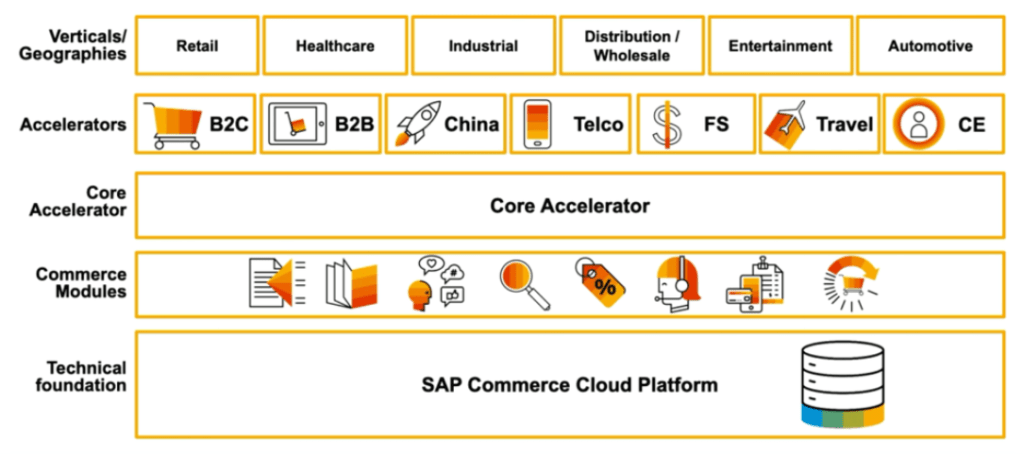
Accelerator
The name says for itself, Accelerator helps us to achieve whatever we require in a speedy way.
- Every accelerator is delivered with source code that acts as a template.
- It comes with sample data, functioning store fronts, and best practices
- The standard use case of an accelerator may already fulfill a reasonable percentage of your requirements. Otherwise, they can be customized to any degree.
- The accelerator design is Omni-Channel from the ground up. It ensures that the customer is connected across all touchpoints.
- All shared functionality has been moved into a core library (core lib acc) which is required for the other more focused accelerators.
- After selecting an accelerator template as a starting point, you can add new functionality to the accelerators by adding various localextensions.xml file
- Rebuild and restart the SAP Commerce Cloud server to update the system
- Multiple B2C and B2B instances can be run on the same server. Their storefronts and catalogs can be managed separately inside the Cockpits and Backoffice.
B2C Accelerator features
- Price, stock totals (real, fake, hidden, quantified, etc), add to cart
- Buy online and pick up in store (BOPIS)
- Checkout, express checkout, and guest checkout
- HOP (redirect to alternative payment processing (paypal for example))
- Search Engine Optimization (SEO)
- Shipping methods
- Cancel order
- Customize product
- Support ticket
- Write review, show reviews.
- Share products on facebook, twitter, etc.
- Manual suggested list (out of the box available), SAP marketing cloud Context driven services compatible
- Potential promotions
B2B Accelerator features
- Organization management
- Spend control
- Customer account management
- Volume and customer group pricing
- Order replenishment
- Order approval
- B2B specific checkout
- B2B advanced product search
- Future stock availability
- PunchOut functionality
- Allows B2B customers to peruse a supplier’s online catalog and save their items and cart as a requisition in their own procurement system.
- After the purchase is approved, the actual order is sent back to the B2B site for processing.
- In order to create and assign PunchOut credentials, B2B customers must already exist in the B2B Accelerator.
- Early Login (with Secure Portal Addon)
- Sales Organization & Commerce quotes
To sum up , B2C & B2B functionalities are discussed , there are also industry specific accelerators and business specific accelators that SAP commerce powers, Please let me know your thoughts & let me know if I need to write more on this.
Thanks!! Stay safe. Avoid crowded areas , wear masks and follow social distancing!

 Add to cart