Magento, This word gives immense energy to me, though I have worked with multiple platforms, Magento is where my heart stays.
We have witnessed a tremendous spike in ecommerce in the last 12 months due to covid, all retailers/sellers now want to Go digital ,selling their goods online.
Though giants such as Amazon, Facebook/WhatsApp provides an arena to make this happen, small and medium scale business strive to establish their brand and their digital presence
The Retailers also find it difficult to manage their catalog and inventory if multiple personas such as 3PL, Distributors & Drop shippers come into picture.
Here comes Magento, Adobe commerce has a played a unique role in enabling medium & big scale business/brands to go online and sell their goods.
We as commerce consultant need to step into business/customer shoes, think about how can we enable them to go digital & try to understand their pain points and draw a complete commerce ecosystem.
As we know everyone wants a marketplace, the prime idea is to understand few things before we can implement a market place.
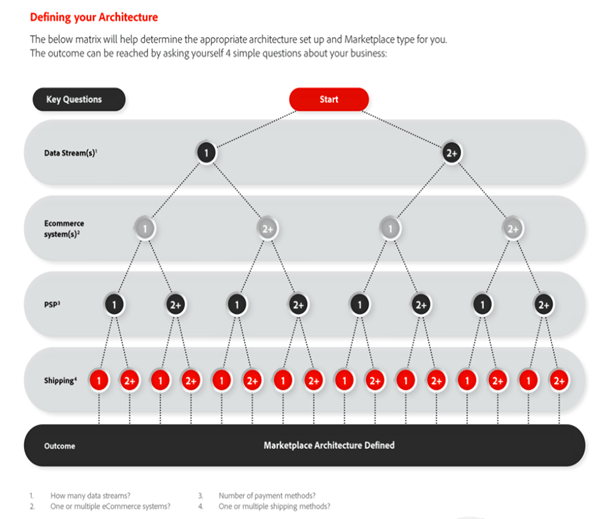
The questions below will help us in outlining the needs of the Business Quickly.
Such as.
- How many data streams.
- One or multiple ecommerce systems
- Number of payment methods used.
- One or multiple shipping methods.

Dividing Market places.
Market places can be segmented. To start off with Market places, consist of a company which has to gather all inventory details which is then uploaded into a market place platform. Selling through a market place either one’s own or owned by someone else, can transform a local business into an international business in a short period.
The second important point that a marketplace should do is processing payment. The market place should have a payment processer to deal with payments on behalf of the sellers
The third point is ability of a market place to digest the order on behalf of the sellers.
The last component is that a market place requires a customer service setup.
ArchitectureThere are several pointers which determine the ecosystem of a market place, in other defining the architecture.
There are several pointers which determine the ecosystem of a market place, in other defining the architecture.
The three segments include.
- A market place for a B2C ecosystem
- A market place for a B2B ecosystem
- A final one B2B2C ecosystem where they want to engage with customers directly.
Architecture Simplified
The below 4 rows indicates the following top to below.
1.Data streams,
2.Number of commerce systems.
3. Number of payment methods.
4. one/Multiple shipping methods.
The implementations might be difficult to follow, let me include the Magento’s store/Store view/Website concepts so that you can understand it much easier.
Websites
Magento installations begin with a single website which by default, is called Main Website. You can also set up multiple websites for a single installation, each with its own IP address and domain.
Stores
A single website can have multiple stores, each with its own main menu. The stores share the same product catalog, but can have a different selection of products and design. All stores under the same website share the same Admin and checkout.
Store Views
Each store that is available to customers is presented according to a specific view. Initially, a store has a single default view. Additional store views can be added to support different languages, or for other purposes. Customers can use the language chooser in the header to change the store view.
Some Jargons also before we proceed
- Company- The wholesaler who is the owner or say Merchant owner- Magento Admin in simple words
- Retailer – a storeowner who access the market place to make a purchases
- Consumer- Customers like you and me
- Client- Wholesaler/Bulky guy whom the company delivers.
B2C Systems
Single Store Market place
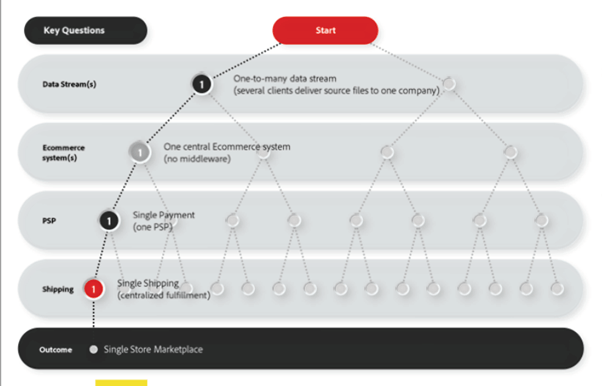
The single store market place consists of.
- One Data stream (might be multiple ones combined into main stream
- Once central commerce system (Magento commerce engine)
- One website which comprises of one single payment processor.
- One centralized fulfilment centre
Multi website Marketplace
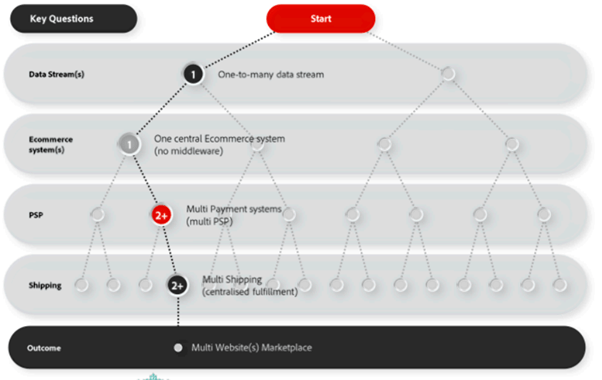
- Multiple Brands
- Each and every brand has a separate website and store view.
- Obviously separate website and store view will have separating listing, URLS/SEO
- Mutliple payments & shipping methods
Multi Source Marketplace

- Multiple clients
- The vendor pim can be directly connected to the commerce system or can be merged into a single point and fed via a middleware
- Each Vendor/Brand has a individual website
- Multiple shipping methods & payment
- Centralized fulfilment
Mutli source fulfilment Marketplace
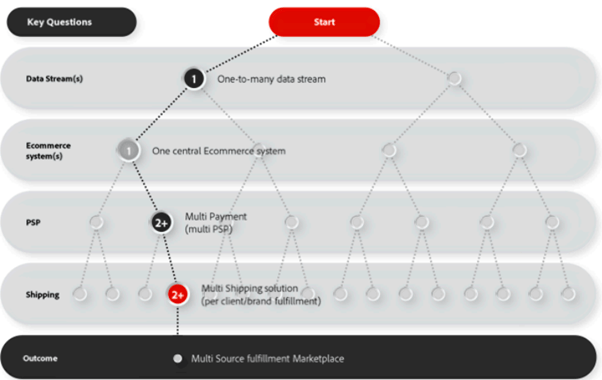
- Multiple clients
- The vendor PIM can be directly connected to the commerce system or can be merged into a single point and fed via a middleware
- Each Brand/vendor has an individual website
- Each website can have different payment methods & shipping options
- And orders from each website routed to individual ERP/WMS by a middleware solution
B2B systems
In majority of the B2B systems are “restricted” & needs a wholesaler to login to use it.In some cases. The logged In/Registered wholesaler might see a different set of catalog prices set
B2B single Store Market place- A wholesaler store

- One website
- One store & storeview
- All the brands are in a single store
- Wholesaler can filter by brands in PLPs
- Prices vary as per guest/Registered users.
- Registered users can be divided into groups to see different prices
B2B Multi-website Marketplace

- Multiple Client
- These clients sell the product of vendors/Brands
- Multiple brands single dedicated wesbsite or storview
- Price per group
- Price per website
- Customers can be shared across website (shared user accounts)
In simple words, the major difference between single store marketplace & Multi website is that, each brand might have its own website and payment method and orders from each website will always have centralized fulfilment only.
Please note: In Magento there is a concept of Customer Account sharing /Scoping, the scope of customer accounts can be limited to the website where the account was created, or shared with all websites and stores in the store hierarchy.
B2B Multi source Marketplace
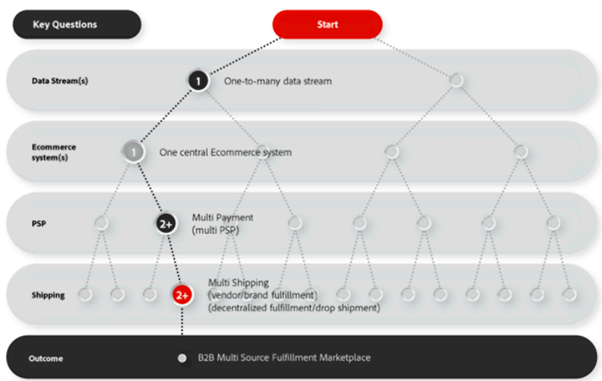
- Multiple clients
- Data from various clients connected to a Datahub
- Vendor PIM’s connected to middleware and it touch bases on single commerce system
- Multiple payment method.
- Each brand will be having its own website/URL/Listing pages
- Price per group (customer group)
- Price per website
- Customer account can be/cannot be shared
B2B2C Systems
White Label Mutli- Marketplace
What’s a Whitle Label Market place ?
White labelling is B2B – you make a product, selling it to another business for them to brand and sell to their own customers. For example, you make and package the perfume in an unbranded bottle, and another eCommerce business buys it, adds their own name label, and then sells it online through their store and online marketplaces
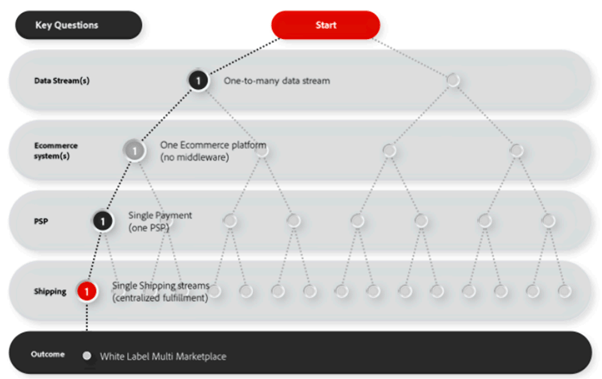
- Multiple Client/Vendors.
- Multiple Vendors/Brands
- One commerce system
- Single website and a payment method
White label Multi website Market place

- Multiple clients
- Multiple Brands/Vendors selling their catalog
- Individual website for each brand so obviously individual store views
- Price per user group
- Price per website
- Customer account may or may not be shared between the websites.
White Label Multi source Market place
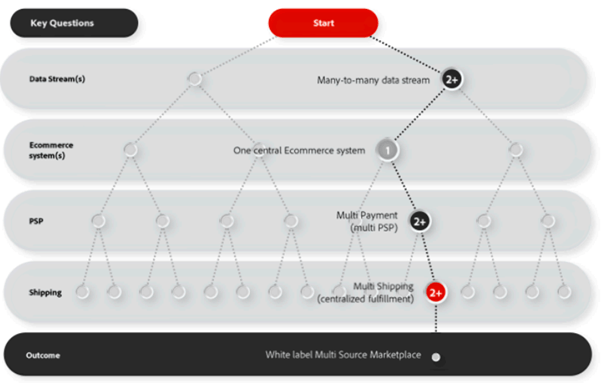
- Mutliple clients
- The Product management systems of brands/Vendors integrated via a Data hub and connected to commerce End point.
- Specific website per client
- Multiple shipping methods
- Multiple payment methods.
- Though its multiple shipping methods, goods are fulfilled from a centralized warehouse
White Label Multisource fulfillment Market place

- Multiple clients
- The Product management systems of Brands/Vendors integrated via a Data hub and connected to commerce End point.
- One central commerce system
- Single dedicated website for Vendors
- Multiple shipping – Vendor/brands have their own fulfilment (decentralized/Drop shipping)
Please note that lot of commerce platforrms are going towards the market place implementation, Jargons might change, but the business model remains the same.

Content & source : Adobe Commerce

 Add to cart