
What is an Order Management System (OMS)?
An order management system (OMS) is the central nervous system of a modern multichannel retail operation. In a nutshell, an OMS conducts the orchestra of systems that process customer orders, assign them to be fulfilled and shipped, track status throughout the process, and synchronize that information across all of the systems and people that need it.
Sounds easy? When retailers sold only through stores, it was a whole lot easier. As sales channels have proliferated, and customer service expectations have increased, the mission of the OMS has expanded.
Now lets quickly see an OMS lifecycle. Im sure, everyone skimming through this will have a vague Idea of how this works, well, let me go into some detailing before you see the picture below, divide the below picture into rows and columns
Three rows are: Shopper experience,Order management & other third party systems.
Three coloumns will be Order capture, order fufillment & Order delivery.
We all smile when the order finally reaches our hands but the below flow picture gives us what are the operations involved which makes us smile.
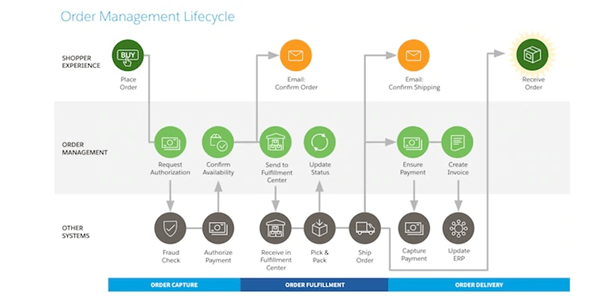
Hope you have got a gist, but again, the flows might vary from business to business but the Vanilla will still remain the same, based on requirements they can do a shake or smoothie out of it.
OMNI-CHANNELING

Seamless experience across all platforms.- Yes ,you read it right!!
My writings are famous, no one wants to go through it and ask me questions 😉, But if you had unluckily gone through my previous posts, I would have used a term Omni-channeling and would have referred it as fancy.
Companies that excel in engaging customers across channels—including web, mobile, social media and in-store—retain more than twice as many customers as companies without effective cross-channel customer care strategies.
To understand the mission of a modern OMS, we need to understand today’s retail challenges.Retailers must excel in multiple sales channels. Or will lose to those who do.
The pressure to sell through multiple channels is immense. From Amazon Marketplace to brick-and-mortar stores, and from catalog orders to eBay, consumers are driving commerce across more channels and platforms than ever.
Customers expect a consistent and coordinated experience across channels
Customers are growing more accustomed to new services enabled by multiple channels:
- I purchased online, and I’d like a telephone rep to change my order.
- I want to make sure the item is in stock before I drive to the store.
- I’m traveling, so I’d like my order delivered after I return, 2 weeks from today.
Traditional order and inventory management software wasn’t designed to work across multiple channels. Customer demands have made change an imperative.
Enter the modern Order Management System (OMS)
Unlike traditional inventory management software, the modern OMS is designed with the end-customers’ experiences in mind. An OMS generates a holistic, centralized, 360-degree view of customer orders and available inventory across all sales channels (stores, marketplaces, ecommerce storefront, distributors), fulfilment centres and customer service channels. The below diagram will make our understanding better.
Why do you need a modern Order Management System?
Today, customers want to buy products, and return them, anywhere and everywhere. Buy online, return in store. They assume that their online orders will be fulfilled and shipped quickly, and exactly as forecasted. They take for granted that the product they want will be in stock. They’re also sharing their experiences more than ever—on review sites, Amazon, and social media. Every bad customer experience can seriously impact your bottom line. The stakes are higher and higher for every single customer interaction.
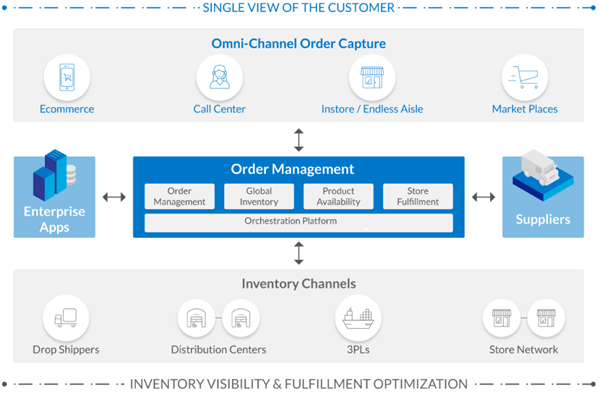
Now we know how an OMS acts as a Central nervous system which touch bases on Commerce & Inventory channels and other third-party applications.
Now what are the features can a powerful OMS be capable of.
The four Important features of OMS.
- DOM- Distributed Order Management system
- Customer Service – Usually couple with commerce system or separate third-party system provide this feature. For example: SAP Commerce provide Ticket raising capabilities which are captured in the commerce Backoffice system.
- Fulfilment- Yes, deals about how & where the order is pick packed
- Global Inventory – How the inventory is managed across all the entities in the commerce ecosystem.
The below diagram will give you a holistic Idea.
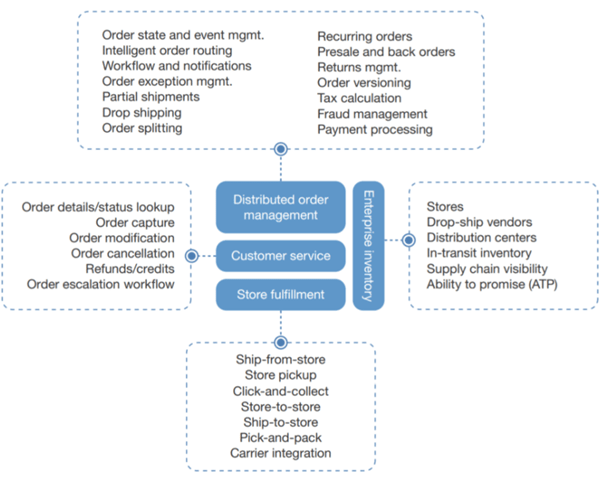
Some benefits of OMS are given below,
In a complex, multi-channel business, each of your products passes through many different teams and locations to get to your customer. A great OMS will save you time and hassle every step of the way:
- Stock products – Centralized inventory management means your business is informed with real-time inventory status, ensuring you keep products in stock for web, phone, and brick-and-mortar sales.
- Process orders – Web, phone, mail-order, or in-person sales are all processed by the same system, so nothing slips through the cracks.
- Route and process – Design business rules for intelligent order routing. You can choose to save on shipping costs by choosing the fulfillment center closest to the consumer. Or you can optimize inventory by shipping from an overstocked store.
- Fulfill – Automated tools generate pick lists, packing slips, and shipping labels with a few clicks, so your fulfillment centers can ship faster.
- Deliver – Advanced shipping integration combines your in-house fulfillment and shipping resources with built-in connections to UPS, USPS, FedEx and more. Eliminate the needless lag of exporting and importing order data.
- Return – Orders update in real-time to one central database, so CSRs(customer reps) can modify any order. You can accept returns through any channel, providing consistently great customer service. Behind the scenes, you’ll keep control of your business with advanced workflows and routing for returns.
How can an effective OMS optimize you Warehouse
An OMS will optimize warehouse selection by its proximity to the order destination. It will then automatically calculate shipping costs and the fastest carriers based on pre-set criteria. It might also print the packing slips, shipping labels, and communicate the change in inventory levels with your warehouse management system.
If a SKU is out-of-stock, the OMS can communicate with your vendors and suppliers to have the inventory sent to that warehouse in advance. Stock-outs can also be prevented if your order management system is able to automatically issue a purchase order when inventory levels are low or hit a reorder point. A reorder point is nothing but a minimum number of units of an item that a business has to have in stock to prevent stock outs and ensure order fulfilment.
Once inventory levels reach the reorder point, this triggers the replenishment process to reorder that particular item. The system can increase employee efficiency by indicating where in the warehouse employees can find the item, what items to ship together, and whether the item requires specialized handling. I will write about Warehouse KPI’s may be in the next post, if that really intrigues you.
Okay too much of verbiage in this. Lets end this post.
A modern Order Management System orchestrates your commerce technology and systems to work in concert and deliver stellar omnichannel customer service. Customer satisfaction, share of wallet, and revenue growth all increase while delivering the efficiency and flexibility needed to adapt to ever-evolving commerce channels and customer expectations.


 Add to cart